
A few years ago, a copy of the Book of Mormon surfaced in the Church History Library that was thought to have been given to Jesse N. Smith by Joseph Smith. Speaking today the Jesse N. Smith Family Reunion, I explained why this is not the book and how to find and identify the actual book.
About the Presentation
- Summary of Main Ideas (published in the Church News, July 8, 2016)
- Selected Slides from the Presentation (PDF)
- Authentic Jesse N. Smith Items in the Church History Library (PDF)
Authentic Sources for Jesse N. Smith
- Portrait of Jesse N. Smith, c. 1864 (Church History Library)
- Autobiographical Sketch, c. 1884 (also published in Andrew Jenson’s LDS Biographical Encyclopedia, vol. 1 (1941), pp. 316-322.)
- Statement, 15 February 1894 (Church History Library)
- Journal, 1904-1906 (Church History Library)
- General Conference Address, April 1905, pp. 50-52
- See also Jesse N. Smith in the Early Mormon Missionaries Database
 An important part of every Pioneer Day celebration involves rehearsing the stories of the pioneers. Stories about the past inspire us today, and they become more effective as they become more complete and accurate.
In the Church History Library, our historians, archivists and librarians have recently worked to learn and tell a better story about a book that has been in our collection for nearly 70 years. I share this behind-the-scenes view of the process in the hopes that it may help improve your family stories.
This Pioneer Day, may we seek to gather all of the pieces of the past that survive and to record all of the family stories that can be told. May we ask good questions that help us read the sources, stories and artifacts closely. May we have discernment to corroborate those facts which can be established and humility to hold on to the questions that remain unanswerable, at least for now.
1. Distinguish the past from stories and questions.
We must first distinguish the past from the stories told about it. The past is gone and the pioneers who lived through it have passed away. Some pioneers told stories about what they experienced and why it was important to them. Their stories are collected, retold (and sometimes embellished) by descendants for many reasons — to entertain, to instill gratitude, or to win an argument.
Today, we can tell better stories by asking good questions about the past and about the stories told by others. Our inquiry is shaped by the sources and stories available, but also by our own assumptions, values and needs. We will likely begin with more questions than answers, but that’s OK because each question gives us a place to start thinking.
In our case, the stories told about a book in our vault caused us to ask: Did Joseph Smith give a Book of Mormon to his cousin, Jesse N. Smith? What happened to the book? Is the book in our vault the one that was given to Jesse?
2. Read closely to corroborate details.
Good questions lead us to look for all of the pieces of the past and stories that we can find — stories written or remembered, books on library shelves, artifacts in attics or heirlooms in trunks. Once found, read closely and ask additional questions: What kind of source is it? Who was the author or creator? When and where and for whom was the source created or the story told? What is the main idea and what evidence supports it? What remains missing or untold?
In the case of Jesse N. Smith, we found an autobiographical sketch in which he stated that Joseph Smith gave him a copy of the Book of Mormon in 1843. We also discovered that Jesse told the story at general conference in 1905, repeating the fact that a Book of Mormon had been given while emphasizing that it was not a first edition (published in 1830) and that it bore a beautiful binding.
3. Read closely to identify provenance and verify authenticity.
We must likewise closely read material artifacts. Was an artifact actually created in the past? Did the purported user actually use it? Where has the artifact been since its creator or user last possessed it?
In the case of the book in the library’s vault, we found that it contained a handwritten inscription on the inside front cover, a typed note pasted in, and some handwriting beneath the note. The inscription stated that the book was given to Jesse N. Smith in 1842. But, as noted above, Jesse said he received the book in 1843. This error suggests that the inscription was not written at the time, a conclusion corroborated by the fact that the handwriting did not match known samples by Joseph or Jesse. The typed note stated that the book was donated to the Church in 1948 by the president of the Mesa Arizona Temple, so we could begin to establish the book’s provenance — the chain of custody from past to present. Other questions remained as yet unanswerable: When was the book donated to the temple? By whom and for what reason?
The handwriting beneath the note said the book had been repaired in 1944, but a closer look at the physical artifact revealed that the “repair” had been very invasive. The spine of the book had been removed entirely and replaced with a flexible substance called buckram. The first and last pages (including the title page) were missing, and those that remained had been roughly stitched together, leaving them uneven and too tight to open. The text matched the layout and typesetting of this edition printed in Liverpool, England, in 1849 — six years later than Jesse reported receiving a book and five years after Joseph had died.
Thus, by comparing Jesse N. Smith’s stories with the artifact in our vault, we concluded that yes, Joseph Smith did give his cousin Jesse a Book of Mormon, but no, this particular artifact is not that book. Most likely, a descendant who recalled Jesse’s story found this 1849 edition, added an inscription, had it repaired, and then gave it to the temple. This means that the actual book given by Joseph to Jesse may yet be out there somewhere, in a library or attic or trunk. When the actual book is discovered, there will be an even better story to tell.
This essay was published in the Deseret News on July 7, 2016.
This article was published in the Deseret News (online) and in the Church News (print). On my blog I summarized this talk and shared the story of Sarah Stageman’s conversion and pamphlet.
Mormon women’s history ‘at a crossroads,’ speaker says
By R. Scott Lloyd, LDS Church News
Published: Thursday, March 17, 2016
PROVO, UTAH
 The director of what he terms “the largest single repository of Mormon women’s history sources in the world” declared that such history stands at a crossroads today.
Keith Erekson, director of the Church History Library, was the opening plenary session speaker March 3 for the annual Church History Symposium sponsored by the Church History Department and the Religious Studies Center at Brigham Young University. The theme of this year’s conference was “Beyond Biography: Sources in Context for Mormon Women’s History.”
“Being at a crossroads in the 21st century isn’t all bad, considering that about a century ago in Mormon women’s history, we were at a no-roads,” Brother Erekson remarked.
“In the earliest [recorded] histories of the Church, women were typically absent,” he said. “In contrast to these Church histories, women were very present in anti-polygamy literature in the 19th century. They’re described as victims, … as defenseless, as slaves, de-literated, downtrodden, dull, senseless, sorrowful, degraded, shapeless, miserable.”
The next generation of writers in the Church responded to such portrayals defensively, he said, and “that defensive stance has really been a part of writing about Mormon women ever since.”
At the turn of the century, in B. H. Roberts’ six volume History of the Church, he presented Mormon women as “noble-minded, high-spirited, intelligent, courageous, independent, cheerful, profoundly religious, capable of great sacrifice,” Brother Erekson noted.
Thus, by the time the Church passed its first century mark, Mormon women had been portrayed variously “as absent, as victims, as profiled notables, as placeholders of designated spaces, and as symbols,” Brother Erekson said.
“It would be left for another generation of writers to ask, ‘Who were these women? Would we recognize them? Whose are the faces under the big-brimmed, pioneer sunbonnets?’ ”
Later in the 20th century, “Mormon women historians began to look at women and their experience with polygamy, their experience as men left on missions,” he said. “This generation found women active in the Relief Society and other auxiliaries, active in Utah politics and the national quest for suffrage. We began to explore and understand in ways we never had before the leading sisters of the earliest generations of the Church’s history.”
Brother Erekson said that at this point, a crossroads, it is appropriate to ask: “How can we place their lives and their stories in context? What can be learned from more systematic analysis?”
Much, it turns out, largely because of the proliferation of sources of late.
In the Church History Library alone are some 9,000 diaries and autobiographies of which nearly 1,600 are written by women, Brother Erekson said.
A team of cataloguers processes about 500 print and rare materials a month, he said. “I also have a team that processes our archival materials, collections that range from maybe two or three letters to 150 boxes of letters and correspondence and papers. We work through about 300 of these collections a month.”
He invited history enthusiasts to come to the library but said they don’t even have to do that to access its holdings. The library has worked in partnership with BYU to post digital images that can be accessed through history.lds.org.
“Today we have 6.8 million digital images available right now on the catalog; 2.7 million were digitized in 2015 alone,” he said.
Brother Erekson announced to the audience that the library has now published “a brand new research guide to women and Church history; you’re the first to hear about it.”
He said, “Go to our website. Click on ‘Women in Church history.’ … We’ve got links to the minutes, to the handbooks, to periodicals, to the histories. We’ve included research hints. … For example, the Young Women organization in the Church has had about half a dozen names over its history. So one of the hints here tells you what those names are and what years the names applied so you could find the kinds of records you would be looking for.”
Brother Erekson said another way the library is working to make sources available digitally is to provide sources cited in the new “Gospel Topics” essays at lds.org, which cover such topics as Mother in Heaven, and Joseph Smith’s teachings on priesthood and women.
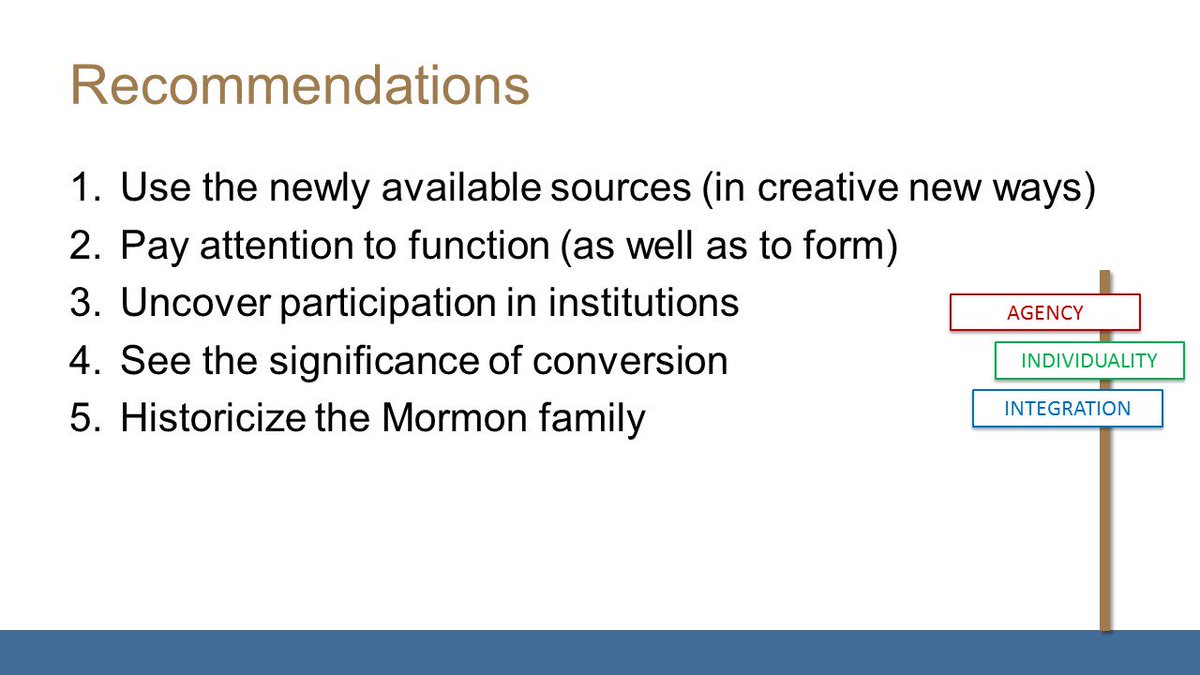
Brother Erekson invited researchers to be creative in the way they use sources, to pay attention to the function women served in the Church as well as the form, and to work harder to uncover women’s participation in institutions.
“Look at impact; look at change,” he said. “That story is told from the perspective of conversion. … We might look at our Mormon Pioneer Overland Travel Database not as a record of people who walked but of people who converted. And we could start to find them and ask about their experience. Together with the new missionary database, we’ve got powerful tools to look at the story in a larger scale.”
Brother Erekson concluded his lecture with some “don’ts.”
“Don’t omit women. Ever.
“Don’t just add women somewhere as a vignette or a sidebar or a chapter or a section or on a pedestal.
“Don’t see women only as wives and daughters and as auxiliary members. There’s so much more to be seen, to be understood, to be contextualized.
“Don’t think that women’s history is only for women or for historians.
“Finally, don’t assume that you have seen all the sources.”
This story of Sarah Stageman–her conversion, her conviction, and her pamphlet–provides a compelling example of how each person can think clearly, value fairness, and quench bad information (pages 157-158).
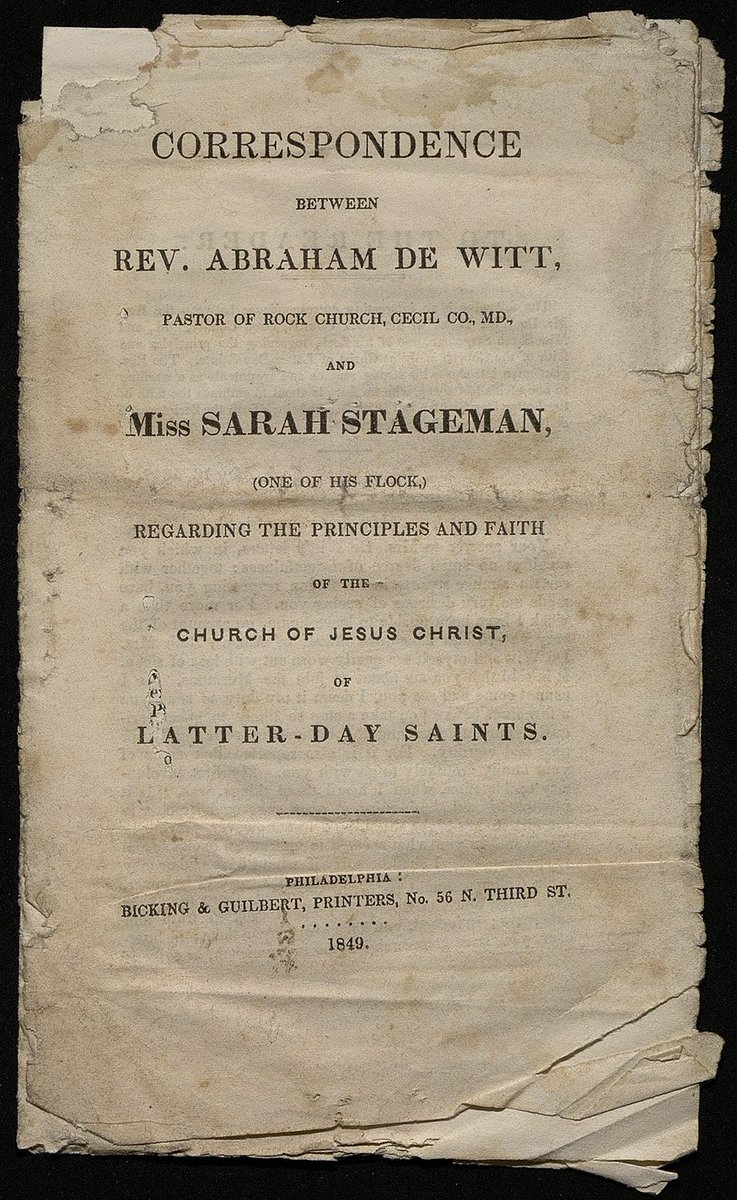
Recently, the acquisitions team in the Church History Library encountered a pamphlet that was not part of our collection. It was understood to be an anti-Mormon pamphlet from 1849, but as we studied its text and placed it into historical context, we discovered that the pamphlet had been gravely misunderstood.
The pamphlet opens with a caustic letter by Rev. Abraham De Witt, the Princeton-educated pastor of Rock Presbyterian Church in Cecil County, Maryland. He condescendingly chastises a young girl for even considering the Church, declaring that she has an “excitable and unstable mind” and warning her to “escape as for your life from this vortex of fanaticism.”
This is clearly an anti-Mormon letter and for this reason the pamphlet was considered an anti-Mormon publication. Accordingly, it was not included in Peter Crawley’s descriptive bibliography or in the original print version of Flake and Draper’s Mormon bibliography. Copies of the pamphlet in other library collections are cataloged with De Witt as its author.
But the pamphlet was not assembled by Rev. De Witt. His letter is presented first so that the girl he attacked could rhetorically demolish it.
Sarah Stageman had been born in England in 1826. When she was 14 years old, she had immigrated to Maryland with her parents and four younger siblings. While in her early twenties, she met and listened to Latter-day Saint missionaries. In her excitement, she consulted with Anna De Witt, who obviously informed her pastor husband. Rev. De Witt poured his scorn into a critical letter that he asked Sarah to share with her family and friends. He followed his own advice by repeating his written message in whispers to his flock. Sarah followed his counsel by publishing his folly.
Sarah begins by pointing out that De Witt had not cited any scripture in his 3 ½ page letter. Accordingly, her 8 ½ page response is a virtual tour de force of the Bible that cites more than 40 passages to testify of the truth of the Restoration, the last days, visions and revelations, Joseph Smith as a true prophet, the apostasy, the gathering of Israel, gospel dispensations, the restoration of priesthood authority, and the workings of God in His own way.
When asked by De Witt how she “made the discovery that Mr. and Mrs. De Witt, and the members of Rock Church and of other Churches, have no religion,” Sarah admits that it came with no help from him. “You inquire of me, if I have clearer views of my need of the ‘Holy Spirit.’ I answer, yes! But, was I confirmed by you, in the laying on of hands, to receive the gift of the Holy Spirit;–as was done by the Apostles”?
Sarah likewise had a ready answer for De Witt’s criticism of Joseph Smith. “You say if Joseph Smith was inspired, why did he locate that temple where it would be begun, but never finished: If he had, you would believe. But the Lord works in his own way. There is a city in Ezekiel we do not read of being built.” She pegged De Witt as like unto the unbelievers of an earlier scriptural age: “I say thus it is now, as it was in the days of Christ. In Mark, Chap. 15, ‘They said, let the king of Israel descend from the Cross, that we may see and believe.’”
No, this is definitely not an anti-Mormon pamphlet. Rather, it is a record of the significance of conversion in the life of a young woman newly converted to the restored gospel of Jesus Christ. Its recovery from misunderstanding exemplifies of one of the ways we might re-engage historical sources to see the significance of conversion in the study of Mormon history.
Citation:
Correspondence between Rev. Abraham De Witt, pastor of Rock Church, Cecil Co., Md. and Miss Sarah Stageman, one of his flock, regarding the principles and faith of the Church of Jesus Christ of Latter-day Saints (Philadelphia: Bicking & Guilbert, Printers, 1849).
- Read the full pamphlet here (digitized in the Church History Catalog).
- See information about the pamphlet in the Church History Catalog.
- Browse other items in the Church History Library by and about Sarah Stageman.
[Note: This discovery and its story were shared as part of a talk I gave at the Church History Symposium.]
This is a great day for women’s sources. We now have access to more and richer sources than ever before. I opened with a review of 19th- and 20th-century writing about women that pointed to several “crossroads” that highlight the need to better understand women’s agency, individuality, and integration into historical writing. In response, I urge a return to the records of, by, and about Mormon women.
In 1950, one historian justified ignoring women by saying, “Although women had reached the threshold of their modern freedom they were still so much the forgotten members of society that little satisfactory direct evidence about them has survived.” In 1977, Davis Bitton reviewed fourteen libraries and archives in Utah and throughout the United States to find nearly 3,000 Mormon diaries and autobiographies, with 489 created by women (17%). Today, in one of those libraries—the Church History Library—there are 9,001 diaries and autobiographies, with 1,596 created by women (18%).
The scope of the work is staggering. In a typical month, the Library processes an average of 500 printed and rare items and 300 archival collections. In 2015, those figures, together with 1,100 collections that were opened to research, mean that more than 10,000 items and collections became available for research in the Library in a single year.
Furthermore, over the past few years millions of pages of historical sources have been digitized and placed online. The Church History Library coordinates with the BYU Library to post thousands of periodicals and other sources on archive.org. We have posted another 6.8 million images in our online catalog. In 2015, 2.7 million images were posted online, a rate of 307 per hour, or in other words, during the time we are together today another woman’s diary will be posted online. As a result, all of the sources in the new volume of Relief Society documents are already in the catalog, as are most of the sources cited in the Gospel Topics Essays about mother in heaven and about priesthood, temple, and women. To assist with future research on Mormon women, we today published a new research guide on “Women in Church History.”
Today more than ever we must pay heed to the warning of Emmeline B. Wells that the “historian of the present age will find it very embarrassing to ignore woman in the records of the nineteenth century.”
The final segment of my talk made these recommendations for historical writing:
I closed with a list of “Don’ts.” The list is obvious, but I offer them here because, well, people still do them. The best histories of the future will place women in context and provide nuanced understanding, but these make for a clear starting point.
Let’s move #LDSwomen’s history beyond biography #CHsymposium pic.twitter.com/BrAhShs1zo
— Keith Erekson (@KeithAErekson) March 3, 2016
[Note: This is a summary of the talk I gave this morning at the Church History Symposium. Future posts will provide additional links, sources, and stories.]
Commentary
A packed house for the first #CHSymposium plenary speaker, @KeithAErekson, on sources in Mormon women’s history. pic.twitter.com/FMpuxcsFuO
— Benjamin Park (@BenjaminEPark) March 3, 2016
.@KeithAErekson: this is impressive. In span of presentation, another women’s diary was digitized. #CHSymposium pic.twitter.com/XOuDEtoChW
— Benjamin Park (@BenjaminEPark) March 3, 2016
@KeithAErekson keeps Tweeting while he’s talking. Can’t believe he’s not juggling, too.
— Spencer Fluhman (@spencerfluhman) March 3, 2016
The hooting and hollering at @KeithAErekson‘s list of Don’ts for historical writers was me. That was me. 🙋🏻 #CHsymposium #LDSwomen
— Eliiiiiiiiizaaa (@EtotheNev) March 3, 2016
.@KeithAErekson pres. on sources & directions in Mormon Women’s History is a must for the field. #CHSymposium pic.twitter.com/LCWcFAQq7W
— Juvenile Instructor (@MormonHistoryJI) March 3, 2016
From the Religious Studies Center blog (March 7, 2016): “Speaking at the BYU Church History Symposium on March 3, 2016, Keith A. Erekson, director of the LDS Church History Library, shared impressive statistics about the library’s digitization of sources, announcing a new research guide on ‘Women in Church History.’ The library houses the largest collection of Mormon women’s history in the world. He urged the sympathetic audience, ‘Don’t omit women, ever,’ eliciting a cheer. He added, ‘Don’t think women’s history is only for women or historians.’”
This essay was published on January 28, 2016, in the Deseret News and the Church News.

The Church History Library has recently placed several new items on display in its “Foundations of Faith” exhibit. An ancient papyrus, a record of the first general conference, and the handmade sketch that accelerated the construction of temples over the past two decades are among the items that make the Church’s organization and growth relevant to visitors today.
The oldest item that has been added to the exhibit is a fragment of papyrus scrolls, which date from the second century B.C. The scrolls were acquired by the Church in 1835 after having been discovered in Egypt.
Shortly thereafter, Joseph Smith began translating the book of Abraham.
The scrolls were sold to multiple parties in 1856 and most may have been destroyed in the Great Chicago Fire of 1871. Later, 10 fragments were discovered to be held by the Metropolitan Museum of Art in New York City, where Kirtland-era paper was attached to the back side as reinforcement. The fragments were transferred to the Church in 1967.
Visitors can also now see two items from the Church’s first general conference on June 9, 1830. At the meeting, Joseph Smith Sr. was ordained to a ministerial position and the certificate of his ordination was signed by Joseph Smith and Oliver Cowdery.
Fifteen years later, Lucy Mack Smith dictated a narrative of her life and family. In her history, on the page open to display, she gives emphasis to the priesthood ordination that is documented by the record created at the time of the event.
The “Call to Save Grain” was written in 1876 by Emmeline B. Wells as an editorial in the Woman’s Exponent, which launched a Relief Society program that influences the Church to this day.
The article inspired women to gather and guard wheat carefully, loan it to the poor, and share it in times of drought. These relief efforts expanded in 1906 when the women sent wheat and other supplies to San Francisco after an earthquake and to China during a famine. In 1978, the Relief Society officially transferred its wheat to the Church’s Welfare Services program. The grain storage initiative thus served as a forerunner to the Church’s welfare, family and humanitarian services programs.
The youngest item in the exhibit is a sketch created by President Gordon B. Hinckley in June 1997. After reflecting on how to help faithful Saints in outlying areas receive the blessings of the temple, he drew a floor plan for a smaller temple with only the essential facilities. He announced the concept at the October 1997 general conference and by August 1998 the first small temple had been completed in Monticello, Utah. Since 1997, more than 50 small temples have been constructed or announced in 19 additional countries and 17 U.S. states where none had been before.
The exhibit’s self-guided tour pamphlet has been revised to answer common questions, to explain how the documents are preserved, and to draw out stories about the experience and impact of women as well as the Church’s worldwide mission and growth.
The “Foundations of Faith” exhibit opened in September 2014, promoted a dramatic increase in visitors to the library, and served as the core of an extremely successful youth conference experience last summer. An online version of the exhibit is available at https://history.lds.org/exhibit/foundations-of-faith.
The Church History Library is open Monday through Friday from 8 a.m. to 5 p.m., with extended hours on Thursday evening until 9 p.m. and on Saturday from 10 a.m. to 3 p.m. The library preserves important records so that we may reflect on, write and understand history. Admission to the library and exhibit is free and open to the public.


