
The University of Texas at El Paso turns 100 years old in 2014 and will mark the occasion with an epic celebration.
Keith Erekson’s job is to make sure the party goes off without a hitch. Although wrapping a century of history into a yearlong celebration is daunting, he may be the perfect person to get people excited about the university’s history.
Erekson’s an assistant professor of history at UTEP, but he isn’t strictly interested in history; he studies what makes people passionate about history and helps teachers teach history in a more interesting way.
Perhaps it stems from having had bad history teachers in high school, but Erekson, 36, began his career in the automotive industry in Brazil. He went to the South American country as a missionary for The Church of Jesus Christ of Latter-day Saints.
In the 1990s, he worked for Johnson Controls in Brazil, building seats for GM, Ford and Toyota, but left in search of purpose.
“It was boom times, but I had a moment – I actually remember the day – when I woke up and I thought, ‘You know, there are 1,237 more seats in the world because of me. Who cares?’” Erekson says.
So he decided to try history. He earned a master’s degree in history from Brigham Young University, loved it and went on to earn a doctorate in history from Indiana University.
Erekson, who is married with four daughters, joined the UTEP faculty in 2008 and is the founder and director of the university’s Center for History Teaching and Learning.
In 2011, he received the University of Texas System Regents’ Outstanding Teaching Award.
Erekson is the author of “Everybody’s History: Indiana’s Lincoln Inquiry and the Quest to Reclaim a President’s Past,” and editor of “Politics and the History Curriculum: The Struggle over Standards in Texas and the Nation.”
Erekson sat down with El Paso Inc. and talked about why the big celebration is so personal to so many people, what Abraham Lincoln and Pancho Villa have in common, and what he sees in UTEP’s future.
 Politics and the History Curriculum
The Struggle over Standards in Texas and the Nation
Edited By Keith A. Erekson
“What’s the matter with Texas? Outsiders too often dismiss it as an overgrown and ignorant child, shrouded in right-wing politics and fundamentalist religion. But that view is itself a gross caricature, as this close study of history and myth-making in Texas demonstrates. Rooting their story firmly in the social and political history of the Lone Star State, Keith A. Erekson and his colleagues bust a few big myths themselves. Read this book if you want to understand why Texans continue to contest their shared past, and why the rest of us should stop condescending to them.” – Jonathan Zimmerman, professor of Education and History, New York University
“In these behind-the-scene essays, history educators and all citizens interested in history education will find chilling accounts of how the conservative Christian right played power politics to ensure that young Texans learn a largely white-washed U.S. history while remaining uneducated about world history. The essays in this important book give voice to teachers and history professors who were steamrollered by the Texas Board of Education.” – Gary Nash, Professor Emeritus, Department of History, UCLA; Director, National Center for History in the Schools
View more Praise about this book
The politicians and pastors who revised the Texas social studies standards made national and international headlines. However, much of that coverage was sensational and squeezed the process into a narrow ‘culture war’ storyline. Politics and the History Curriculum sets the debate over the Texas standards within a broader context by exploring the tangled and powerful mixture of politics, religion, media, and education. This volume provides a clear analysis of what happened and why, along with sensible recommendations for teachers and policy makers
ISBN: 978-1-137-00893-0 || $85.00 hc || Available June 2012
[Cross-posted from transformations.utep.edu]
In December 2011, UTEP President Diana Natalicio appointed me as her special assistant for centennial program implementation, a job description that includes supporting the 2014 Commission, carrying out historical work (researching, writing, speaking), and overseeing internal coordination (planning, budgeting, and following up). For the internal work, I will seek to:
- Integrate centennial activities into the daily work of the university, whether the participants are staff (merit evaluation), faculty (tenure and promotion), or students (grades).
- Encourage self-interest by not inviting “service” but rather helping participants ask “How can I use the centennial to accomplish the work I already do in _________________?”
- Welcome all contributions from all contributors, from paid employees to passionate volunteers. I hope people will ask “What can I do better and with more passion than anybody else?” and then do it.
- Organize skills and interests into project-specific teams, from oral history to museum exhibits to opera performances.
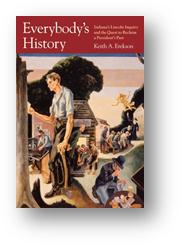 In crafting this implementation philosophy I am explicitly taking a page from the work of the Lincoln Inquiry, a group of over 500 Americans who studied Lincoln’s Indiana boyhood nearly one hundred years later during the 1920s and 1930s. I wrote about them in Everybody’s History and now I am trying to apply their work to my situation today. The Lincoln Inquiry organized hundreds of volunteers on the basis of skills, enthusiasm, and urgency (chapter 1). Its participants pursued oral histories with those still alive who had known Lincoln (chapter 3) and crafted a well-researched narrative (chapter 4) that they defended in public (chapter 5). I don’t foresee the need to compete with other historians and biographers to tell UTEP’s story (chapter 2) and I really hope to avoid their greatest shortcoming–the inability to integrate their research findings into a coherent synthesis suitable for a wide range of public audiences (chapter 6).
I will talk about the book and its application to centennial planning this Friday, February 24, at 3:00 p.m. in room 323 of the Liberal Arts Building on the UTEP campus.
BOOK ALERT from the UNIVERSITY OF MASSACHUSETTS PRESS
Everybody’s History: Indiana’s Lincoln Inquiry and the Quest to Reclaim a President’s Past
By Keith A. Erekson
A volume in the series Public History in Historical Perspective
$26.95 paperback, 264 pages, 12 black-and-white illus., ISBN 978-1-55849-915-7
http://www.umass.edu/umpress/title/everybodys-history
To place orders: Hopkins Fulfillment Services, Amazon, Barnes & Noble, or your independent bookstore.
Review copy policy: The University of Massachusetts Press will provide complimentary review copies to members of the media (including journals, newspapers, magazines, radio, television, and online media) who intend to review the book. Review copies can be obtained by contacting our Promotion Department at kfisk@umpress.umass.edu. Reviewers in the UK can obtain copies via our European distributor, Eurospan, by contacting katie.rushforth@eurospangroup.com.
 Dr. Keith A. Erekson has been appointed by the president of The University of Texas at El Paso, Dr. Diana S. Natalicio, to oversee planning for the celebration of the University’s centennial in 2014. Erekson will coordinate both the study of the institution’s history and the planning of commemorative events and programming.
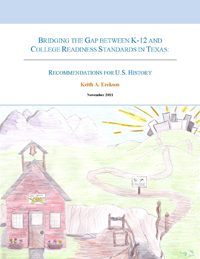 A new report authored by Erekson and published by the Texas Faculty Collaborative for Social Studies created a small firestorm in the media, claiming state and national headlines during the same week in November 2011 that Americans voted in the general election, Rick Perry said “oops” in a Republican primary debate, Penn State fired Joe Paterno, and Herman Cain and Justin Bieber responded to critical allegations. After a liberal political activist organization wrote a press release that tacitly distorted the nature of the report, the story spread like wildfire through liberal media outlets until it escalated into a “damning,” “slamming,” and “ripping” attack by the Texas Higher Education Coordinating Board on Texas governor and presidential candidate Rick Perry. Thankfully, more sensible journalists soon waded in to remind the public that the report provides numerous clear recommendations for addressing two daunting challenges facing K-16 history educators in the state of Texas–dozens of overlapping educational standards and a crisis in K-12 college preparation. [Click here to learn more]


